
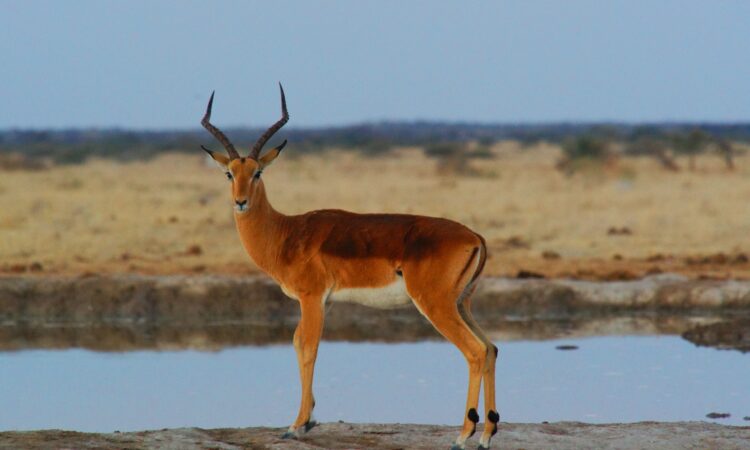
Searching for antelope species in Masai Mara National Reserve? The most common antelope species that you will see while in the Masai Mara National Park includes the following. These animals are easy to see during game drives and are an important part of the wildlife in the reserve.
Types of Antelopes in Masai Mara
Below are some of the types of antelopes in Masai Mara National Reserve.
Beisa Oryx
The Beisa Oryx is one of the antelopes found in the Masai Mara National Reserve. The male and the female look alike, which makes it hard to tell them apart. The females usually have slimmer and shorter horns. They have long ears with a lot of hair and strong bodies. Like most antelopes, they mainly eat grass and live in open areas.
Coke’s Hartebeest
Coke’s Hartebeest is known for its long face and wide forehead. It has sharp horns, a long back, big chest, pointed ears, and long legs. These antelopes move in groups that can range from 20 to 300 members. They mainly feed on grass and can run at speeds of about 70 kilometers per hour when in danger.
Common Eland
The Common Eland is one of the largest antelopes in the Masai Mara National Park. It is the second largest after the giant eland. Both males and females have twisted horns, but the male horns are slightly larger. These horns are used for protection against predators. Elands are calm animals and are often seen grazing in open areas.
Gerenuk
The Gerenuk is also known as the giraffe necked antelope because of its long neck and small head. It has a reddish brown body. Male gerenuks have slim horns that are shaped in a triangular form. They usually live in small groups of about 5 to 6 members. Females take care of the young ones and are very protective.
Impala
The Impala is one of the most common antelopes in the Masai Mara National Reserve. It is medium sized with a slender body and long neck. Only males have horns, and these horns are long and curved. Male impalas live in bachelor groups of up to 30 members, while females live in larger groups that can reach up to 100 members.
Kirk’s Dik-Dik
Kirk’s Dik-Dik is the smallest antelope in the Masai Mara National Park. It is very careful and alert because it is often hunted by predators. Its name comes from the sound it makes when frightened. It has a fast metabolism, which means it eats often to survive.
Thomson’s and Grant’s Gazelle
Thomson’s and Grant’s Gazelle are among the most common antelopes in the Masai Mara National Park. Thomson’s gazelle was named after Joseph Thompson, also known as Tommie. These gazelles weigh between 40 and 80 kilograms. They are easy to recognize by their black stripe, black tail, and short horns. They prefer open grassland areas.
Topi
Topi are fast antelopes that can run up to 90 kilometers per hour when in danger. They are similar to hartebeests but have clear differences in body shape and color. They are often seen standing on small raised areas to watch for predators.
Common Waterbuck
The Common Waterbuck is a large and strong antelope. Male waterbucks have long horns that can grow up to 100 centimeters. These horns are used to fight for territory. These fights can be dangerous for both animals. Waterbucks are often found near water sources.
Blue Wildebeest
The Blue Wildebeest is one of the fastest antelopes in the Masai Mara National Reserve. It can run up to 85 kilometers per hour. It has a beard and a long tail. Males are larger and heavier than females. Wildebeests are well known for moving in large numbers during migration.
Antelope species in Masai Mara National Reserve are easy to see and play an important role in the ecosystem. They provide food for predators and are part of the Kenya safari experience. During your visit, you are likely to see many of these animals across the reserve.


